Better Habits for Better Numbers: Conversational AI for Sales Reps
TLDR: SMB sales teams need high CRM data quality to manage deal volume, but informal communication channels make updates burdensome for reps. LLM-powered agents address this by letting reps log updates via natural language, while planning and digest agents help reps prioritize and give managers synthesized insights.
Context
At Fairmart, I found managing a sales team selling to SMBs had specific challenges. Low ACVs have to be offset by higher deal volume and velocity, and this pushes sales managers to rely heavily on CRM data to understand pipeline health. At the same time, SMB sales reps have to put up with more manual work because the customers they target are typically less digitally savvy. This means more in-person meetings, one-on-one meetings, and informal communication channels such as WhatsApp, which all translate to manual CRM updates for the reps.
Problem
There are two sides to this problem: higher deal volume and velocity necessitate a data driven approach. Yet data capture is precisely more difficult for SMB segments due to fragmented, siloed, and informal communications. SMB sales managers then hound their reps for CRM updates, which are hard to streamline due to the nature of their communication channels. The net result is that the sales manager resorts to individual conversations with his reps to get vital details. This reduces the manager’s effectiveness since they spend more time hunting for information than finding ways to move deals forward.
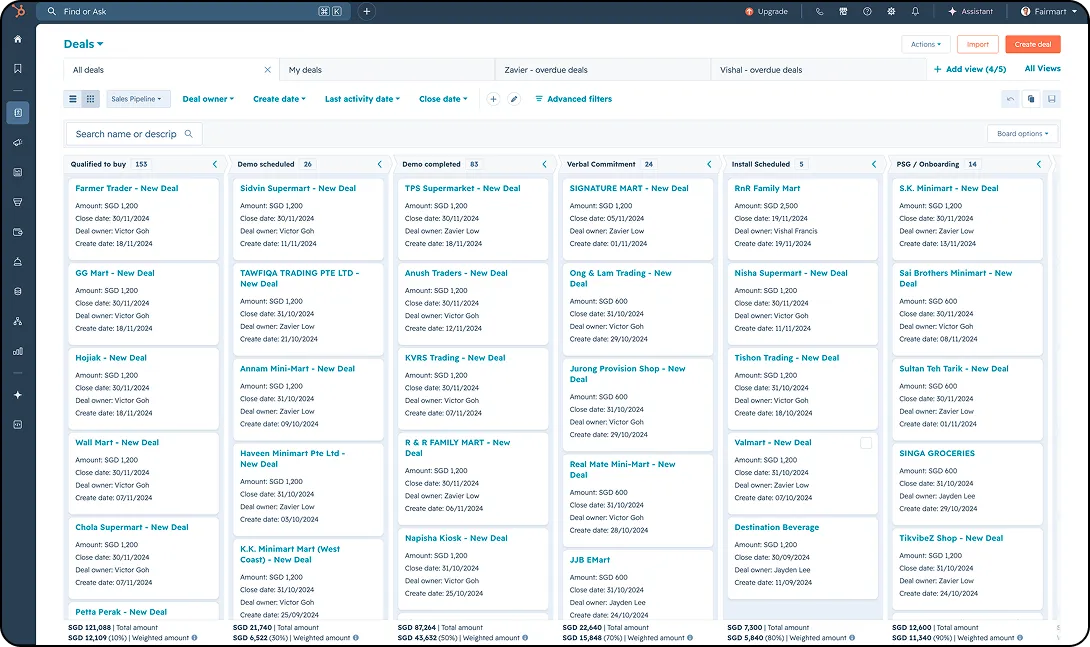
The consequence is that there is a substantial asymmetry between the value a sales manager derives from CRM usage versus their sales rep.
Solution
Our concept addresses this problem from two angles:
- make CRM updates dramatically easier
- make CRM data useful for the sales reps
Making CRM Updates Easier
LLMs enable new data capture methods to aid sales reps in reporting. We implement an agent that takes natural language inputs (text and voice) and converts them into CRM record updates on behalf of sales reps.
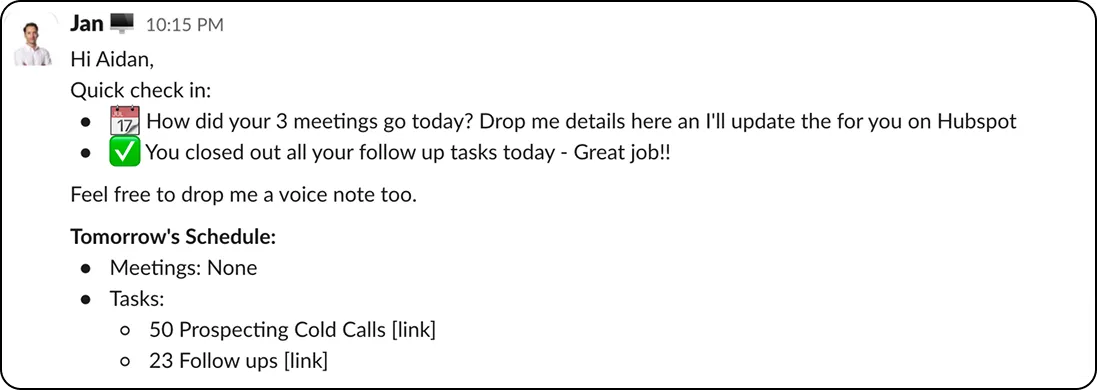
We use existing company communications channels, such as WhatsApp, Slack, or Google Workspace Chat, so sales reps do not need to onboard to a new tool. Sales reps are prompted daily to provide an update on the meetings and tasks they had scheduled on their calendars, and asked to review updates for accuracy prior to writing to the CRM. If sales reps are on the move, they can dictate their updates which are then turned into structured updates for the CRM.
Improving CRM Utility
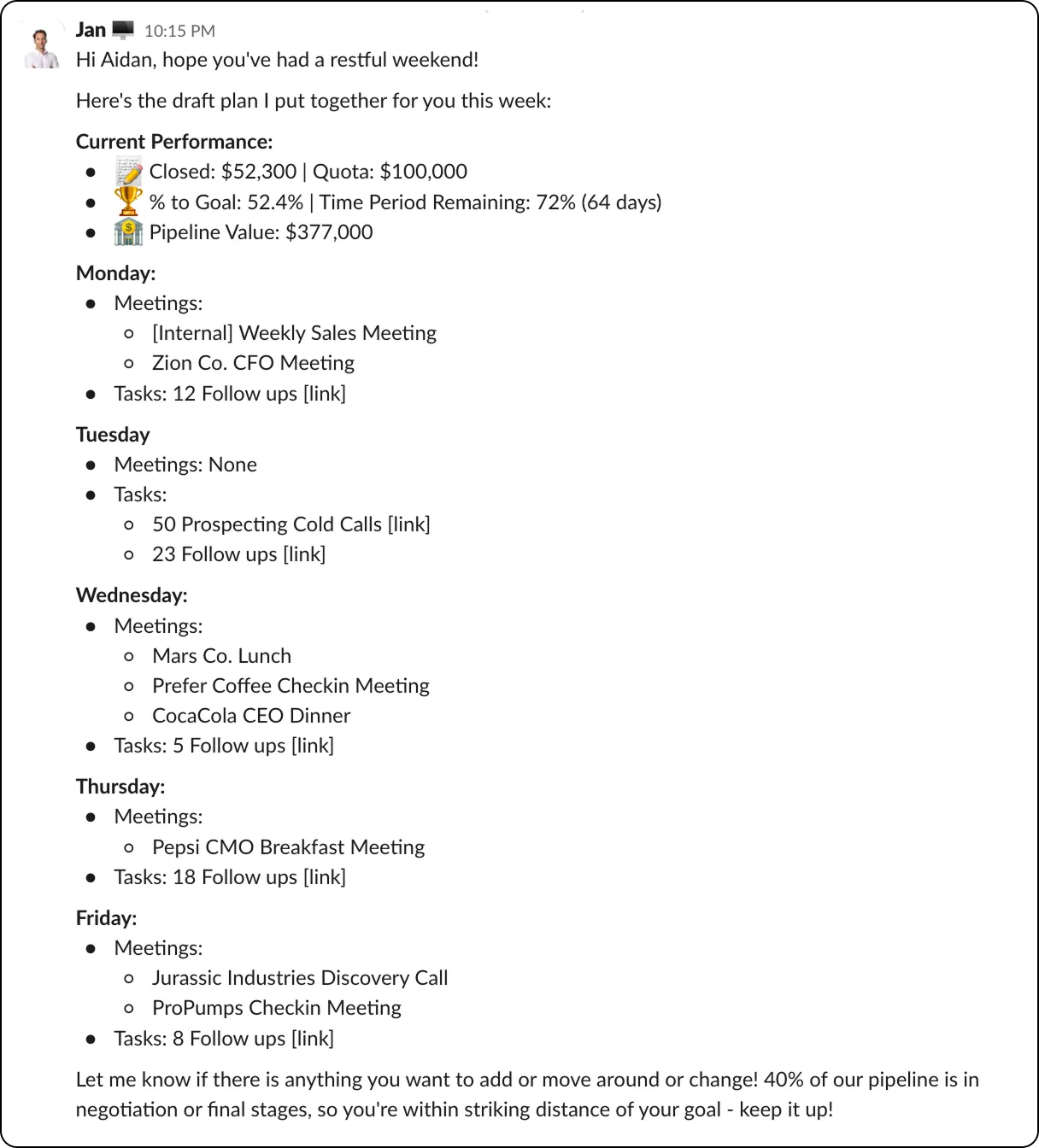
We support sales reps further by helping them plan their weekly tasks. Our planner agent reviews open deals, time of last activities, and proposes a realistic task list for the week, broken down by day. Sales reps provide feedback on proposed plans that surface client realities and improve pipeline accuracy.
For example, in response to a proposed follow-up, a rep may say that a decision maker stated that they don’t have a budget this quarter; this information would then recommend the rep to demote a deal from live opportunity to lead for follow up next quarter. This recursive loop improves utility to sales reps while improving data quality by creating the incentives to communicate.
Implementation
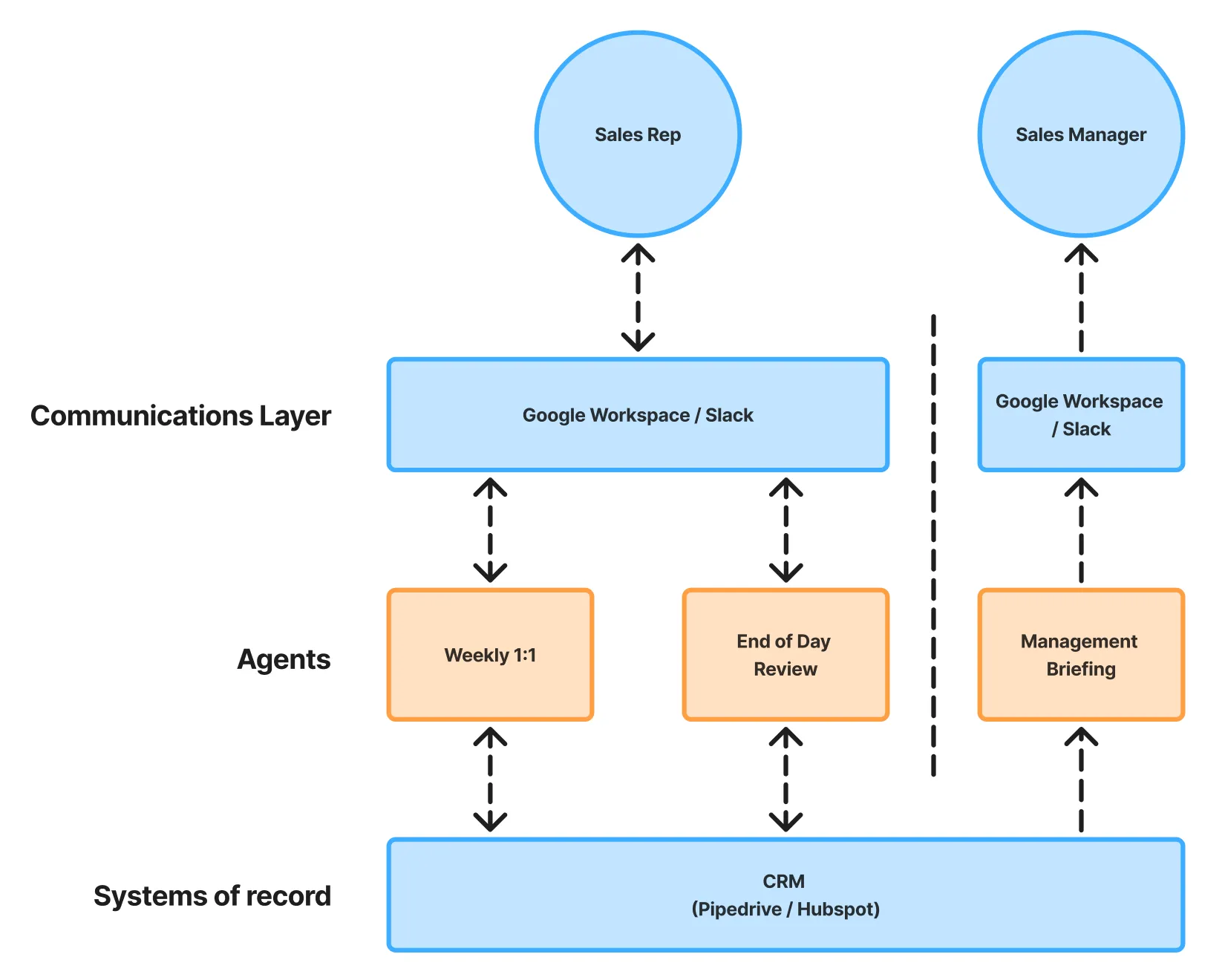
Our solution is implemented as a series of information collection and retrieval agents:
- Sales Rep Weekly 1:1 Agent
- Lists out scheduled meetings / tasks for each week day
- Proposes additional followups based on open deals
- Dedicates specific prospecting time
- Solicits feedback from sales rep to customise the plan
- Once confirmed, handles calendar + CRM updates for additional tasks / meetings
- End of Day Review Agent
- Uses Weekly 1:1 plan as input for review
- Solicits updates from sales rep on meetings / tasks for the day
- Drafts CRM record and pipeline updates for rep to review
- Once confirmed, updates CRM records on reps behalf
- Sales Manager Digest Agent
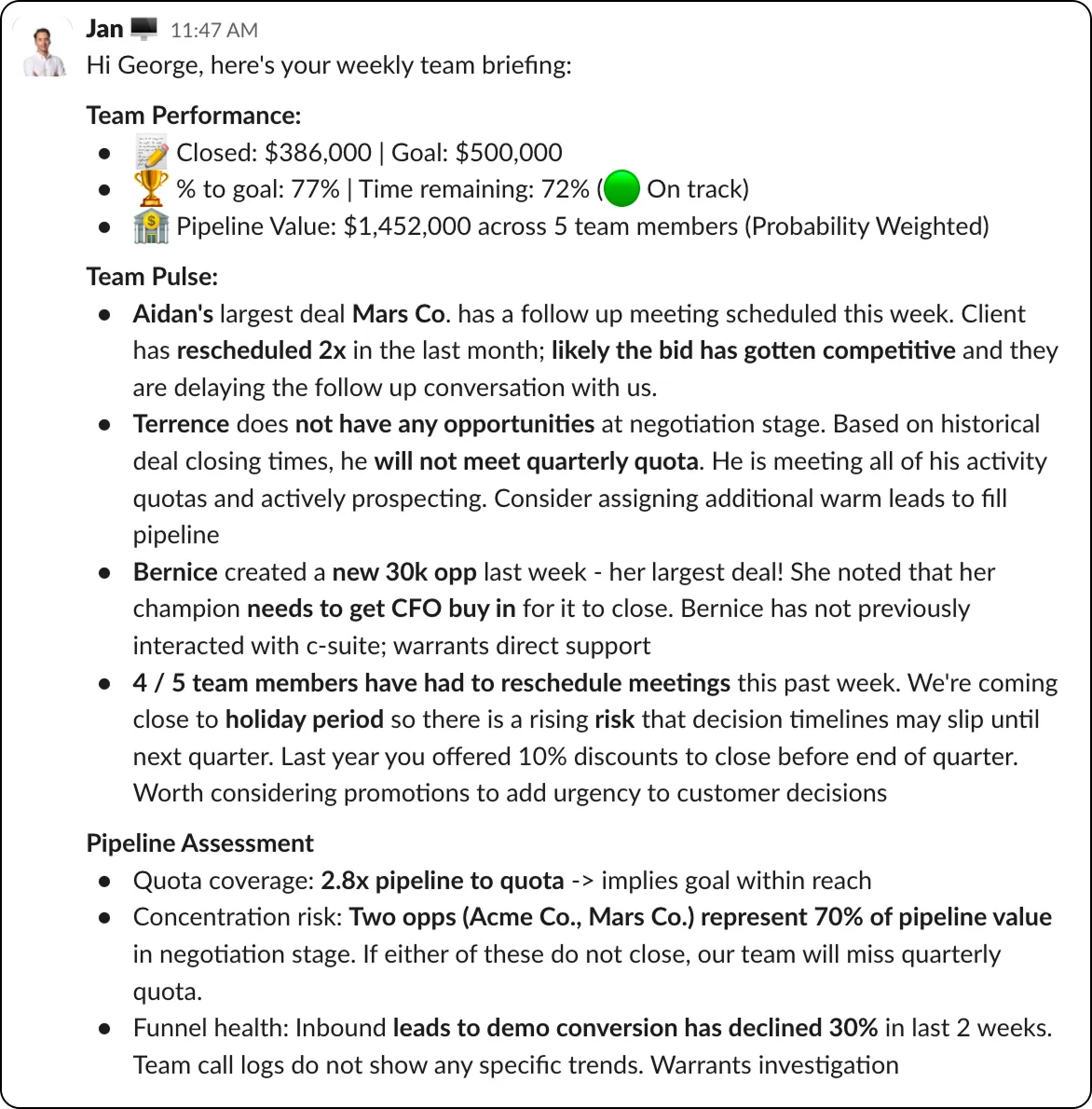
- Reviews sales team updates and applies configurable prioritization score (eg. stage, revenue)
- Identifies repeating lowlights from sales team updates for potential training / process improvements (eg customer not available; could not close because x missing)
- Selects team highlights to support weekly sales meeting learnings
- Provides links to specific records referenced for sales manager to review indepth
- Weekly or daily digest cadence depending manager preference
Our agent layer sits between your organization’s communications layer and your systems of record. Updates to any records are tagged as agent generated, clearly differentiating human vs agent updates.
What We Don’t Do
We explicitly do not do any externally facing content such as customer email drafts, or call scripts. Existing GTM tools handle this already and requirements vary greatly across sales teams. Our focus is solely on improving internal sales operations.
How we Measure Success
Our hypothesis is that by reducing data input friction, we can improve both data timeliness, data quality, and - most importantly - data utility for sales teams.
Our sales manager briefings build upon improved data ingestion by making it equally accessible, reducing the need for manual manager review. This supports sales managers’ decision quality by adding nuance and detail to record-keeping, while automating key information extraction. Sales managers can act faster on what is important in driving the outcomes they are responsible for.
Specific metrics we target are:
- 10% improvement in sales rep closing rate
- Weekly internal CSAT: % of surveyed reps rating the tool 4–5 out of 5.